My husband thought our wedding night would be the perfect place to humiliate me: three hundred witnesses, society photographers at the edges of the ballroom, my sister glowing in gold as he announced that she—not me—was the woman he had loved for a decade, and a crowd cruel enough to applaud while the bride stood frozen in diamonds and white silk.
Chapter 1
My husband thought our wedding night would be the perfect place to humiliate me: three hundred witnesses, society photographers at the edges of the ballroom, my sister glowing in gold as he announced that she—not me—was the woman he had loved for a decade, and a crowd cruel enough to applaud while the bride stood frozen in diamonds and white silk
1,791 words
He believed I was too polite to expose him, too quiet to fight back, and too in love to notice the hotel receipts, jewelry purchases, hidden emails, and legal documents he had slipped into our wedding paperwork, but when I took the microphone and calmly interrupted their dance, the first phone in the room began to ring...
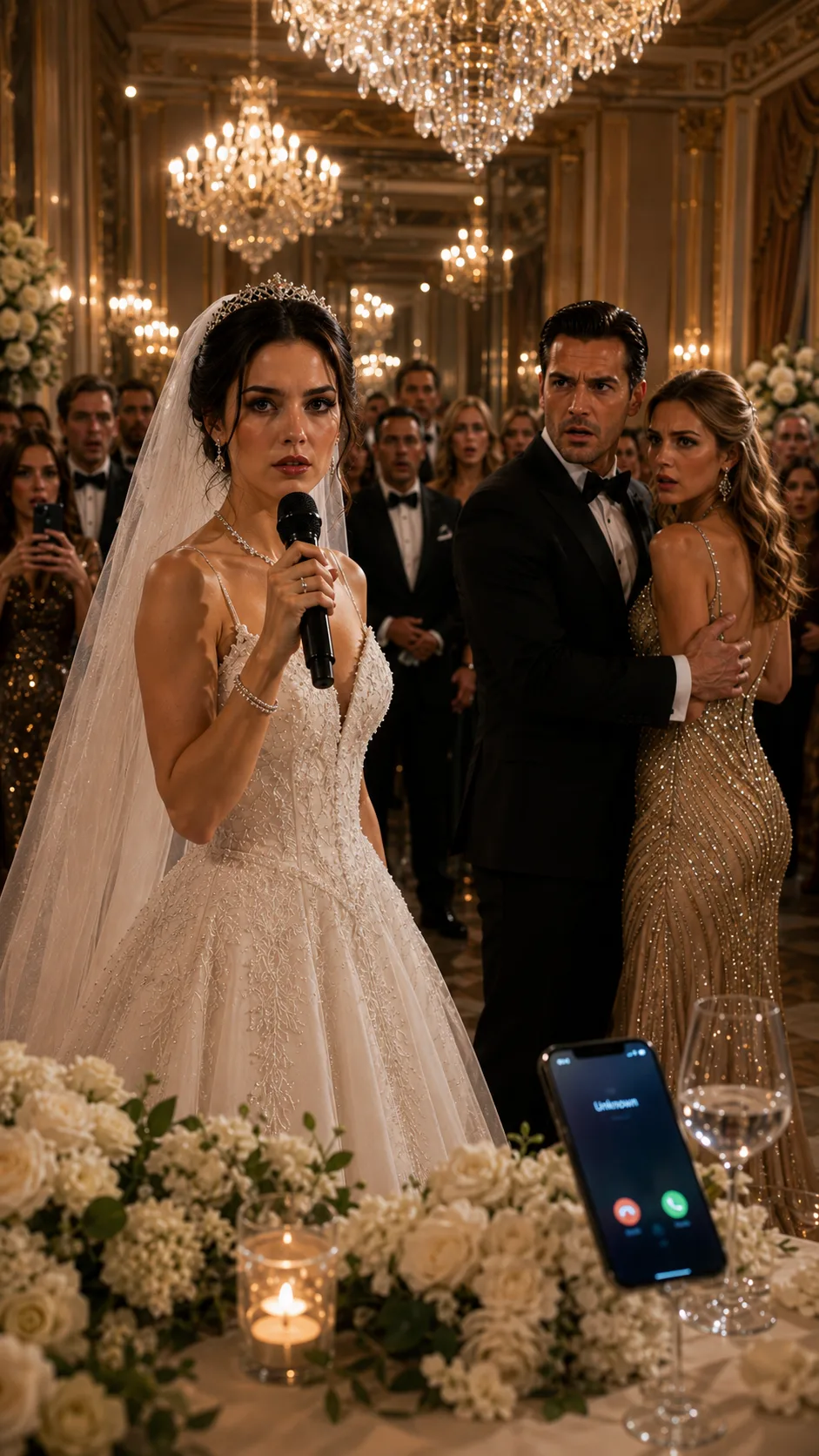
The music was so loud I almost didn’t hear the tiny sound my own heart made when it split open.
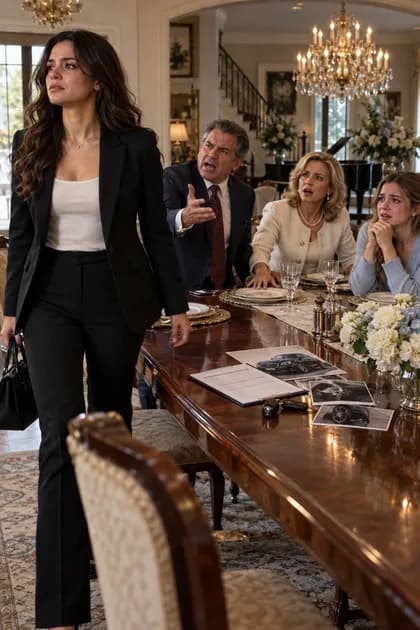
For the rest of my life, I would remember the ballroom exactly as it was in that moment: the crystal chandeliers burning above us like captured constellations, the polished marble floor reflecting every candle flame, the scent of white roses and champagne and expensive perfume hanging thick in the air, the low glittering murmur of three hundred people who had come to watch a wedding and were about to witness something else entirely.
I would remember the way my veil brushed the bare skin between my shoulder blades whenever I breathed, the way my grandmother’s diamonds pressed cold against my scalp, the way the bodice of my silk gown held me upright when my knees briefly forgot they belonged to a body that could stand.
Adrian Vale stood in the center of the ballroom with a crystal champagne flute raised in one hand and the microphone in the other, smiling like a man who had never once doubted that a room would turn toward him when he asked it to. His tuxedo had been made for him in Milan. His cufflinks had belonged to his grandfather. His hair, black and glossy and perfectly swept back, looked untouched by the long ceremony, the photography session, the receiving line, or the private chaos that always runs underneath a wedding like wiring inside a wall. He
looked handsome. He looked victorious. He looked, I understood later, like a man already celebrating the theft before the safe had fully opened.
“This dance,” he said into the microphone, his voice warm and rich enough to make older women smile into their champagne, “is for the woman I’ve loved for ten years.”
The crowd softened at once. I felt it happen around me, that collective intake of breath that comes when people believe they are about to be given a romantic story. My mother’s eyes filled. My father, who had spent most of the day wearing the armored expression of a man paying for beauty while examining every person who came near his daughter, finally let his shoulders drop. My bridesmaids leaned toward one another. A society photographer at the edge of the dance floor lifted her camera with renewed interest.
And I, like a fool, felt my heart
surge.
For one blinding, humiliating second, I thought he meant me.
I was his bride. I was standing only a few feet away in a white silk gown that had taken three fittings, two emergency alterations, and more money than Adrian had paid for his first car. The dress had been designed to look simple from a distance and devastating up close: heavy Italian silk, clean lines, a long fluid train, tiny hand-sewn pearls along the inner edge of the neckline that only appeared when the light shifted. My bouquet sat on the sweetheart table behind me, white peonies and gardenias tied with a ribbon from my mother’s wedding dress. My veil was pinned with diamonds my grandmother Eleanor had worn when she married my grandfather in a courthouse ceremony during a thunderstorm in 1956. I had built the day around inheritance, elegance, continuity, and restraint. I had believed, even after everything I had discovered, that there would be a moment when the truth could arrive cleanly.
I took one step toward him.
Adrian walked past me.
He did not hesitate. He did not glance sideways. He did not even give me the courtesy of pretending to be torn. He simply crossed the marble floor with the same polished confidence he used in boardrooms, country clubs, and private investor dinners, and he stopped in front of my younger sister.
Vanessa pressed one hand to her chest as if astonished.
It was a beautiful performance. Too beautiful. Too practiced. Her lips parted in a perfect little circle. Her lashes fluttered. The gold dress she had chosen caught the chandelier light with every breath, clinging to her like poured metal, the same dress she had held against herself in my closet three nights earlier while asking whether it was “too dramatic” for a wedding.
I understood then that the question had never been a question.
It had been a joke.
Adrian extended his hand.
Vanessa looked at me, just once, and the smile that arrived on her face came too quickly. Too brightly. Too hungrily.
She had known.
No. Worse.
She had been waiting.
The guests erupted.
Some clapped immediately, instinctively, before their minds caught up with what their hands were doing. Others laughed in that uncertain way people do when they are trying to decide whether cruelty has been sanctioned by confidence. Someone near the back whistled. One of Adrian’s college friends slapped another man on the shoulder like he was witnessing the most daring toast of the decade. The quartet faltered. I saw the first violinist look sharply at the wedding planner, who looked at Adrian, who made a small circular gesture with two fingers, ordering the music to continue. After one terrible second of confusion, the violins slid into something slow and romantic.
A love song.
At my wedding.
For my husband and my sister.
Adrian placed his hand at the small of Vanessa’s back and guided her onto the dance floor. Vanessa rested her cheek against his shoulder, her eyes still open, still fixed on me over the clean black line of his lapel.
That look said everything.
You lost.
I bit the inside of my mouth so hard I tasted blood.
The pain helped. It gave my body something simple to understand while the room rearranged itself around my humiliation. Blood. Pressure. Breath. Floor. Light. Sound. Facts.
I had trained myself in facts long before Adrian decided to mistake me for an ornament.
The whispers began almost immediately.
“Was Claire the backup?”
“I heard he and Vanessa were close before the engagement.”
“Poor thing.”
“She always was the quiet one.”
“Do you think she knew?”
“She looks frozen.”
“She’s not going to recover from this.”
The last one almost made me laugh.
People always got that wrong about quiet women. They believed silence meant surrender. They mistook restraint for fragility. They saw a woman standing still and assumed she had no weapons because they had never bothered to learn the shape of weapons that did not make noise.
Adrian had built his entire future on that mistake.
He thought I was useful, not dangerous. The polished fiancée. The respectable surname. The bride investors liked. The daughter of Robert Ellison, chairman of Ellison Mercer Holdings, whose family office controlled voting interests in three regional banks, a medical technology portfolio, two shipping entities, and enough real estate to make ambitious men speak softly around my father. Adrian thought my value lived in access: my last name, my family’s boardrooms, my trust, my signature, my ability to make people who distrusted him lower their guard.
He thought I was the sort of woman who would smile through canceled dinners, unexplained transfers, secretive phone calls, and a sister who wore innocence like perfume while dripping poison into everything she touched.
He thought I had not noticed.
That was the part that almost insulted me more than the affair.
He thought I had not noticed the way he turned his phone facedown whenever I entered a room. The way Vanessa suddenly owned diamond earrings after his “conference” in Zurich. The way they exchanged glances at family dinners, not passionate glances, not even guilty ones, but impatient little looks, as if I were a locked door delaying people who had already decided the house belonged to them. He thought I had not noticed the charges from private villas, hotels, couriers, jewelry boutiques, consulting accounts, and holding companies that appeared in places he assumed I did not know how to find.
He thought I had not noticed the legal documents.
That was his fatal mistake.
Because the woman he chose to humiliate under six million dollars’ worth of flowers was not only a bride.
She was an attorney.
And not the kind of attorney Adrian seemed to imagine when he told people, with faint amusement, that I “helped with contracts for the family.” I had graduated second in my class from Columbia Law. I had spent four years in mergers and acquisitions at a firm where men twice my age learned not to slide vague language past me unless they enjoyed losing skin in redline comments. I had left private practice to work with my father’s family office because he asked me to help modernize governance after a cousin nearly sold a voting block to a private equity group with the ethics of a shark tank. I understood trusts, proxies, shell entities, board approvals, emergency succession language, related-party beneficiaries, spousal access clauses, and every subtle little sentence people use when they are trying to move power without calling it theft.
Adrian knew I had a law degree. He even admired it when it made me useful.
He just did not believe I would use it against him.
That, too, was a family trait. Men like Adrian love accomplished women until accomplishment becomes inconvenient.
My maid of honor, Lila, caught my wrist. Her nails dug into my skin hard enough to hurt.
“Claire,” she whispered, her face pale beneath her makeup, “don’t make a scene.”
I turned toward her.
Lila had been my best friend since freshman year of college, the only person in that room besides my father’s counsel who knew even part of what was coming. She had helped me keep breathing through the last eight months of surveillance, evidence gathering, and the slow disintegration of my engagement behind closed doors. She knew what Adrian had done. She knew what Vanessa had done. She knew I had a plan.
But even she had not known he would do this.
Not here.
Not like this.
“No,” I said quietly, taking my hand back. “I’m about to end one.”
Then I walked toward the microphone.
Chapter complete
You have reached the end of this chapter.
Continue reading
Find your next story
A few more worlds to get lost in after this chapter.