Power, Bella Hayes had learned, never really announced itself.
Chapter 107
Mafia Boss Insults Waitress In Sicilian—Then Froze When She Responds Back Fluently
1,325 words
It didn’t need to.
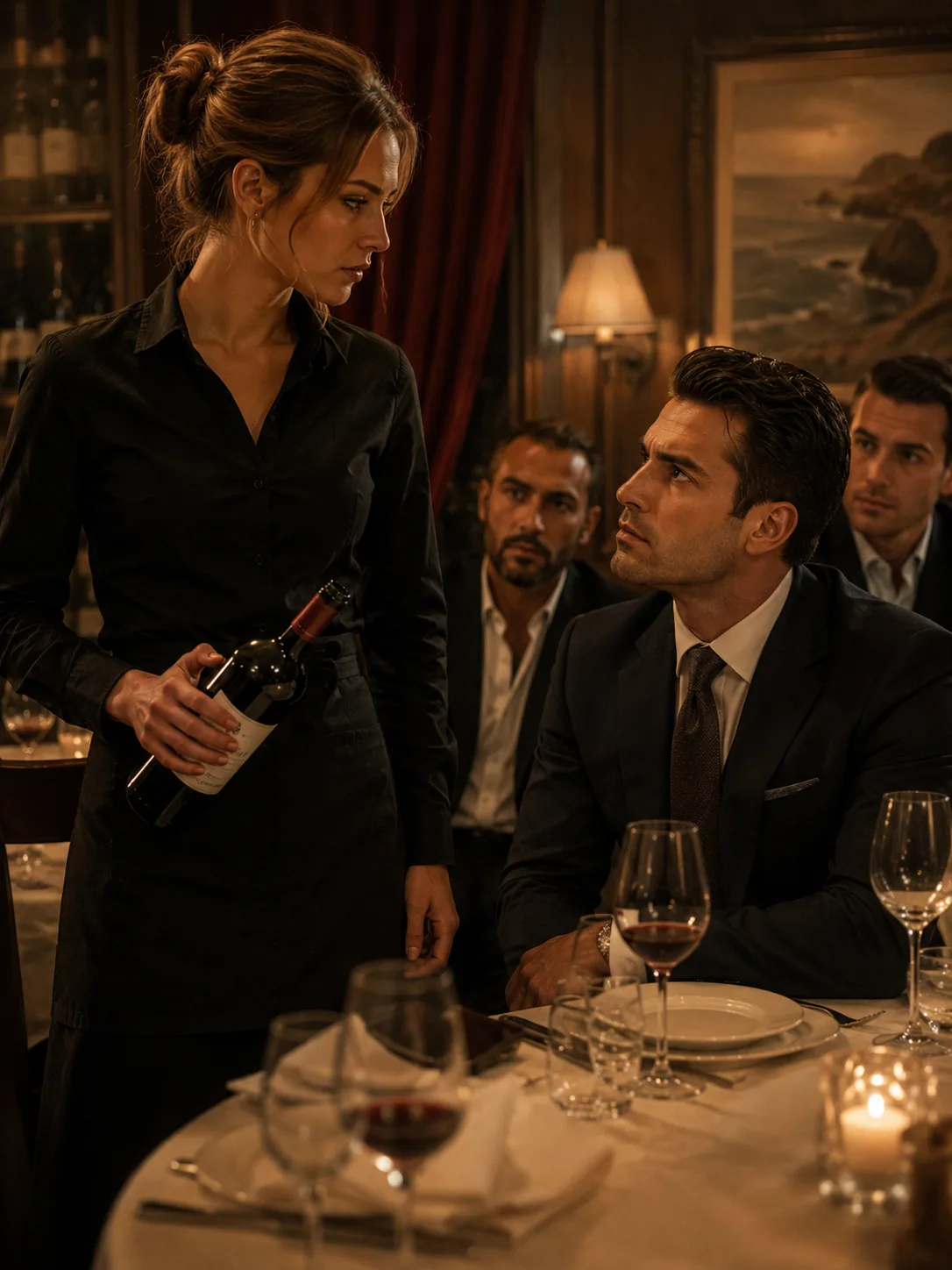
It lived in the kind of silence that made a room full of wealthy people lower their voices without knowing why. It lived in the glance exchanged between men in tailored suits and men with prison scars hidden beneath gold cuff links. It lived in restaurants where the wine list was longer than some family Bibles and the private booths were screened with velvet curtains thick enough to muffle a threat.
La Stella, tucked into Boston’s North End on a narrow street that smelled of rain, garlic, and old brick, was one of those places.
Tourists came for handmade pasta and candlelight. Politicians came for discreet back-room dinners. Judges came because no one took pictures here. And men like Dominic Costa came because the owner knew exactly when to stop asking questions.
Bella balanced a tray of crystal glasses on one hand and moved through the
dining room with her head slightly bowed, her expression neutral, her body trained into the invisible rhythm of service. Smile just enough. Speak just enough. Never linger. Never invite attention.
For almost three years, invisibility had kept her alive.
“Table twelve needs the Barolo,” her manager, Ron Delaney, hissed from the service station. He was sweating through his collar again, which meant somebody important had arrived.
Bella didn’t look toward the curtained alcove at the back, but she felt it anyway. The pressure in the room had changed. Conversations had grown softer. Even the kitchen line had gone strangely disciplined.
“Send Julia,” Bella said quietly.
“Julia suddenly got a stomachache.”
Ron shoved the bottle into her hands. His fingers were damp. “Go. Pour. Don’t talk. Don’t make eye contact. Just do your job.”
Bella looked at the dark red bottle in her hands. Expensive. Delicate. Heavy.
Then she looked at
Ron.
“Who is it?”
He swallowed. “Dominic Costa.”
The name hit her like a cold blade sliding under the ribs.
Not because she’d never heard it. Anyone in Boston with ears had heard it. Dominic Costa was thirty-three, rich, feared, and officially the owner of several shipping companies, two construction firms, three restaurants, and a charitable foundation that sponsored children’s hospitals. Unofficially, he was the most dangerous organized crime figure on the East Coast. A king dressed as a businessman.
But that wasn’t why Bella’s pulse kicked hard once against her throat.
It was the last name.
Costa.
She drew a slow breath, forced her face blank, and lifted the tray.
“Fine,” she said.
Ron gripped her forearm before she stepped away. “Bella. I mean it. No mistakes.”
She gave a tiny nod and walked toward the curtained alcove.
Each step felt longer than the last.
Her cheap black flats
made no sound on the dark wood floor. The bottle trembled slightly in her hand, and she hated that. Hated the weakness of it. Hated the memory it stirred—another room, another table, another set of men speaking in accents sharpened by power and contempt.
Not now, she told herself.
You’re Bella Hayes from Cleveland.
You’re twenty-six.
You’ve never been to Sicily.
You don’t understand a word but English.
That was the lie she had lived inside for three years, the lie stitched into her fake driver’s license, her forged Social Security card, her leased apartment in South Boston, and the careful flatness of her voice.
She slipped through the velvet curtain.
The noise of the restaurant vanished.
Inside, three men sat around a polished mahogany table scattered with plates, dossiers, and half-finished glasses of amber liquor. The man in the center didn’t need to introduce himself.
Dominic Costa had the kind of face sculptors would ruin trying to make too perfect. Dark hair combed back. Sharp cheekbones. A mouth too controlled to be kind. He wore a charcoal suit that fit like it had been sewn onto him, and his right hand rested lightly on the arm of his chair, a signet ring catching the candlelight.
He was saying something about a union contract when Bella approached, his voice low and even.
Men who yelled needed attention. Men like him already owned it.
At his right sat Luca Moretti, the broad-shouldered enforcer everyone in Boston knew by reputation if not by name. At his left sat Adrian Vale, Dominic’s clean-cut financial adviser, the one who could probably launder a murder until it looked like philanthropy.
Bella kept her eyes lowered.
“Your wine, sir,” she said.
Dominic didn’t answer.
He only looked at her for one second, dismissing her instantly, and returned to his conversation.
Good, Bella thought. Ignore me. Forget I exist.
She stepped beside Luca and tipped the bottle to pour.
At the exact wrong moment, Luca shoved his chair back to grab a folder. His elbow slammed into Bella’s hip.
The bottle jerked.
A slash of Barolo leapt from the neck and splashed across the white cuff of Luca’s shirt.
Silence.
Absolute, terrible silence.
Bella froze.
Luca stared at the stain, then very slowly turned his head toward her. “Are you kidding me?”
“I’m sorry,” Bella said automatically.
His chair scraped as he started to rise.
Dominic lifted one hand without looking at him.
Luca stopped.
The gesture was so small Bella might have missed it if the room weren’t so still.
Then Dominic finally looked up at her.
His eyes moved over her plain uniform, her messy dark-blonde bun, the tray in her hand, the apology already dying on her lips. He saw exactly what she had trained the world to see: a tired waitress, forgettable, unimportant, beneath consideration.
A faint smile touched his mouth, cold and cruel.
Then he turned slightly toward Luca and said, in rapid Sicilian, “Look at her. Clumsy little cow. She can barely walk straight. Get her out of my sight before she ruins something that matters.”
Adrian laughed under his breath.
Luca’s shoulders loosened, his anger turning amused now that his boss had made the girl small.
Bella stood perfectly still.
Inside her, something old and buried lifted its head.
She had heard that dialect once at her father’s table when powerful men wanted servants not to understand. Not standard Italian. Not even ordinary Sicilian. A precise, aristocratic register from old families who believed blood itself had grammar.
She hadn’t heard it spoken aloud in years.
And Dominic Costa, with one contemptuous sentence, had dragged her entire dead life out into the light.
Her fingers stopped trembling.
Her spine straightened before she could stop it.
When she spoke, she didn’t use the flat American vowels of Bella Hayes. She used the voice she had inherited like silver cutlery and old sin.
In flawless Sicilian, cool and elegant, she said, “The wine can be replaced. Manners cannot. Your man struck me first. If you want respect, perhaps begin by showing some.”
The silence changed shape.
Adrian’s glass stopped halfway to his mouth.
Luca blinked once, hard, as if he’d misheard.
Dominic Costa did not move at all.
But the smile vanished from his face.
For the first time, he really looked at her.
Not at the apron.
Not at the tray.
At her.
At the bone structure he now recognized. At the poise no amount of poverty had quite beaten out of her. At the old-world cadence of her speech. At the fact that a waitress in Boston had just answered him in the language of a world that was supposed to be dead.
Bella felt the shock land in him like a bullet.
And with it, terror came roaring back into her own body.
What have you done?
She set the bottle down harder than necessary, turned, and walked out before her legs could give out. She did not run through the dining room. She made herself walk to the kitchen, set down the tray, rip off her apron, and push through the back door into the alley.
The cold air hit her face.
Then she ran.
Chapter complete
You have reached the end of this chapter.
Continue reading
Find your next story
A few more worlds to get lost in after this chapter.