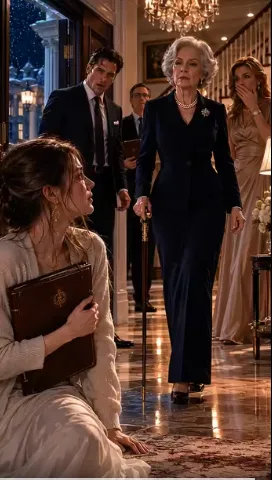
The chandelier was the size of a small car.
Chapter 3
The chandelier was the size of a small car.
Sarah stood in the center of the Vance Imperial's lobby at eleven forty-seven
at night and stared up at it — four tiers of crystal, original to the 1924
construction according to the bronze plaque on the column to her left — and
felt something she couldn't immediately name. Not pride. Not relief. Something
quieter and more structural, like finding a load-bearing wall you didn't know
was there.
The lobby was extraordinary in the way things are when they haven't been
renovated into blandness. Terrazzo floors in ivory and black. Brass elevator
doors with geometric inlaid panels. A front desk of dark mahogany stretching
thirty feet, lit from beneath by warm amber sconces. The whole space smelled
faintly of beeswax and old stone and something floral she couldn't identify.
"Bird of paradise," said the woman beside her. "We've had them in the lobby
since 1987. Your grandmother thought the arrangement
was becoming stale around
then and changed it. Nobody's touched it since."
The woman's name was Delia Marsh. She had worked at the Vance Imperial for
twenty-two years — front desk first, then night operations, then the title of
Night Manager, which she wore with the particular composure of someone who had
seen everything a hotel could produce and remained unimpressed by most of it.
She walked Sarah through the lobby, through the empty bar with its original
tin ceiling, through the mezzanine ballroom with its arched windows looking
out on Michigan Avenue, through the corridor of meeting rooms, through the
service kitchen that was impeccable and organized in a way that spoke of long
institutional habit.
"Your grandmother visited every Tuesday," Delia said, as they passed the
restaurant. "Same table — the corner banquette, by the window. She ordered
the same tea every time. Darjeeling, second flush, no milk.
She always brought
her reading."
"I didn't know that," Sarah said.
Delia glanced at her. Not surprised — something more careful than that.
"She spoke about you often."
Sarah didn't ask what Margaret had said. She wasn't sure she was ready to know.
—
She slept in a guest suite on the eighth floor. The bed was better than any
she'd slept in, which felt like information. She woke at five-forty and couldn't
go back to sleep and lay in the dark for twenty minutes looking at the ceiling,
which had a crown molding plaster medallion that someone had painted the same
soft white as the rest of it — carefully, deliberately, making sure the detail
wasn't lost.
She made coffee herself from the suite's small kitchen and stood at the window
watching the city below in the gray early light. A delivery truck idling at the
service entrance. A
woman in scrubs walking fast on the sidewalk with coffee in
both hands. An ordinary Tuesday morning assembling itself in the dark.
The leather portfolio was on the nightstand. She had not read all of it yet.
There was a final section Henderson had mentioned, past the audit, past the
coercion clause. She had not been ready for it last night.
She opened it now.
Past the hotel deed. Past the trust amendment. Past the financial table with
its two damning columns. The last item was not a legal document.
It was a letter. Handwritten, in Margaret's careful, old-fashioned cursive, on
a single sheet of cream paper.
Sarah,
*I have been watching you make yourself small for five years. I watched your
mother do the same for fifteen before you, and I did not do enough then. I
should have given you this the day you said yes to him. I thought perhaps I
was wrong about what I saw.*
I was not wrong.
*The hotel will ask more of you than you expect. So will everything that
follows. You have both the capacity and the stubbornness for it — you get
the stubbornness from my side, which I consider the better inheritance.*
I am not giving you a gift. I am returning what was always yours.
M.
Sarah read it twice. Folded it back exactly on its original creases. Placed
it in the portfolio in the exact spot it had come from.
She finished the coffee.
—
James arrived at 9:08am.
She saw him through the lobby's glass front — he and Patricia, in the same
car, Patricia's jaw set and James carrying a folder his personal attorney had
clearly assembled overnight. He looked like he hadn't slept. His tie was the
dark green one Sarah had bought him two Christmases ago because it matched
his eyes, which she had once considered a tender thing to know.
The front desk manager — a young man named Marcus who had been briefed by
Henderson's office the night before — intercepted them at the entrance with
the tone of someone who had delivered difficult news to difficult people before.
"I'm sorry, sir, Ms. Miller is not available for visitors this morning. If
you'd like to schedule—"
James: "My wife owns this hotel—"
"Shall I leave a message?"
Patricia tried the side entrance. The security guard there was the taller of
the two from last night. He recognized her. She recognized him. She turned
around.
Sarah watched from across the lobby. She had come downstairs at eight-thirty
and had been sitting at her grandmother's corner table — the banquette, the
window, the bird of paradise arrangement two feet to her left — drinking
Darjeeling because Delia had asked if she wanted anything and that was the
name that had come out.
She watched Marcus handle it. She watched James, through the glass, press
the folder flat against his side as if controlling the impulse to do something
with it. Patricia said something to him, close and low. He shook his head once.
He looked up and found her through the glass.
She held his gaze for three seconds. Then she looked down at her tea.
Marcus returned to the front desk. He didn't come to her table and he didn't
make a gesture in her direction. He simply resumed his morning and let her
resume hers. That restraint was the most professional thing she had witnessed
in recent memory.
—
The management meeting was at ten.
Seven people around the conference table on the sixth floor. They were cautious
in the way employees are when a new owner appears — professional, watchful,
careful about what they volunteered. The CFO kept his folder closed. The head
of operations had printed an agenda nobody had asked for.
Sarah looked around the table and told them she had a degree in economics that
she hadn't used in five years and a great deal to learn about hotel operations,
and she needed sixty days before she would make any decisions about structure
or staffing or direction.
"Nothing changes for now," she said. "Nobody loses their position. The suppliers
stay. The menus stay. If something is broken, I want to know about it directly."
She paused. "If you've been managing around a problem for years because nobody
was listening, I'd like that list."
The room adjusted. Not dramatically. A subtle settling, like a group of people
who had been holding something and were deciding whether to put it down.
The CFO opened his folder.
At the far end of the table, Delia — who had been called in for the morning
meeting on her off hours and had come without complaint — wrote something on
her notepad and slid it sideways to the operations manager without looking up.
Sarah caught the movement. She didn't ask about it until afterward.
The operations manager told her, in the corridor, later: She's a Vance.
Four words. No explanation offered. None needed.
—
Henderson appeared at noon.
James's personal attorney had reviewed the coercion clause, the notarized
amendment, and the financial audit. He had advised his client that contesting
the trust would take years, cost more than the contested assets were worth,
and would almost certainly fail given the clause's activation conditions.
James and Patricia had left the building at ten-twenty.
The portfolio was in Henderson's hands — he was having the original documents
moved to the firm's secure archive. He handed Sarah a single folder: her copies.
"I'll be in touch about the Miller and Company shares," he said. "You have
options there. No rush."
She thanked him and meant it.
—
She went back to the guest suite after two.
Sat on the edge of the bed. The room was the same as the morning — pale winter
light, the plaster medallion, the small kitchen. But something had shifted in
the proportions of it. Or in her, which amounted to the same thing.
Her phone had six notifications. Two from James — the first from nine-fifteen,
which she guessed was from the lobby, and one from eleven-thirty-eight. One from
Patricia. Two from a group text with James's cousins that she had not engaged
with in months. And one from a number she didn't immediately recognize, which
turned out to be James's personal attorney, which was new information about how
her morning had registered.
She didn't open any of them.
She opened her contacts. James's name was there, at the top of her recent calls.
Seven years of history below it — dinner reservations she'd made on his behalf,
questions about flight times, reminders about his mother's birthday. The last
outgoing call to him was four days ago: a brief logistics call about a dry
cleaning pickup. Forty seconds.
She looked at it for a while.
Then she put the phone face-down on the nightstand and went down to the lobby.
The restaurant was quiet in the mid-afternoon way of hotel restaurants — a
few people with laptops, a couple near the window, the sound of a coffee grinder
from behind the bar. Sarah took the corner banquette. Her grandmother's table.
The napkin was folded into a neat rectangle on the plate. She picked it up and
laid it flat across her lap without gripping it, the way you do when you have
somewhere to be and you're not afraid of it.
Delia appeared from nowhere with a pot of Darjeeling and didn't ask.
Sarah had told the management team sixty days. That was probably optimistic.
She knew it when she said it. But she had said it, and it was on someone's
notepad now, and she intended to keep it.
The tea was exactly the right temperature.
She still hadn't deleted his contact.
She would. Just not today.
Chapter complete
You have reached the end of this chapter.
Continue reading
A few more worlds to get lost in after this chapter.