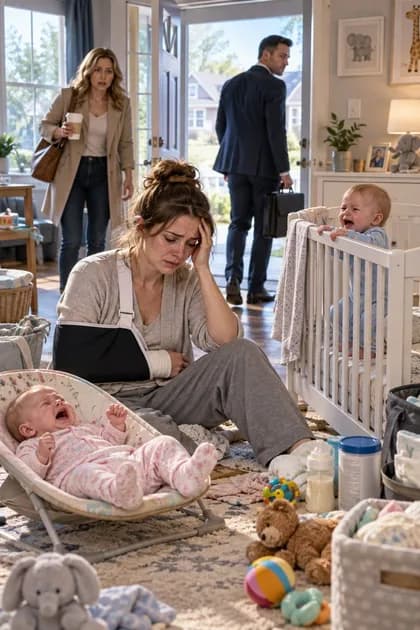
By the time my wife said, “Not my problem,” my eighty-two-year-old mother was already standing at the front door with her hospital bag in both hands.
Chapter 1
WHEN A HOSPITAL RIDE EXPOSED WHAT VANESSA HAD TAKEN
4,644 words
Her appointment was in forty minutes.
My car was in the shop.
And the only working vehicle in our driveway was the SUV Vanessa was holding the keys to.
For a second, I genuinely thought I had misunderstood her.
I looked from Vanessa to my mother, then back again.
“What did you say?”
Vanessa took another slow sip of her iced coffee.
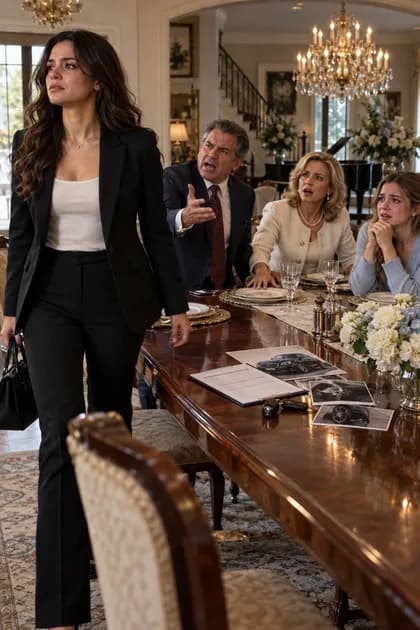
She was dressed for brunch—black yoga pants, spotless sneakers, oversized sunglasses pushed onto her head. My mother stood across from her in a carefully buttoned blue cardigan, clutching her bag against her chest.
Vanessa shrugged.
“I said it’s not my problem.”
The whole house seemed to stop breathing.
My mother’s fingers tightened around the handle of her hospital bag.
I stared at my wife.
“She needs to get to the hospital.”
Vanessa rolled her eyes like I had asked her to cancel a vacation instead of lend me
a car for a medical appointment.
“Then call someone.”
She picked up her designer purse from the kitchen counter.
“I have brunch with the girls.”
That was when my mother lowered her eyes.
And somehow, that hurt more than anything Vanessa had said.
Mom had been awake since five that morning.
I knew because when I walked into the kitchen at six, she was already dressed in her best blue cardigan, her silver hair carefully combed, pretending she wasn’t nervous.
We had waited three months for this specialist appointment.
Three months of tests.
Three months of uncertainty.
Three months of Mom insisting she was “fine” whenever I caught her staring too long at the calendar.
And despite all of that, she had spent part of the previous evening making banana bread.
For Vanessa.
Because months earlier, Vanessa had casually mentioned that she liked my mother’s banana bread.
Mom had even
wrapped an extra slice in foil that morning.
“In case Vanessa wants breakfast,” she had said.
Now the foil-wrapped slice was still sitting untouched on the kitchen counter.
Vanessa never even looked at it.
She looked at me instead.
“You always do this, David.”
“Do what?”
“Make your mother’s problems my problem.”
My mother’s face changed slightly.
Barely enough for Vanessa to notice.
But I noticed.
I had been noticing little expressions like that for years.
Mom trying not to react.
Mom pretending something didn’t hurt.
Mom changing the subject whenever Vanessa made a cutting remark.
Mom telling me not to worry because she didn’t want to create problems in my marriage.
And standing there that morning, something inside me finally cracked.
Not loudly.
Not dramatically.
It was cleaner than that.
Almost peaceful.
Like a rope I had been holding for years had finally snapped, and instead of falling, I
realized I didn’t have to keep pulling anymore.
I nodded once.
“Okay.”
Vanessa blinked.
For the first time, she seemed uncertain.
She had expected an argument.
Maybe she expected me to beg.
Maybe she thought I would remind her that the SUV she called “her car” was a vehicle I had paid for, insured, maintained, and kept running.
Maybe she expected me to bring up everything my mother had done for us.
Especially what happened when Vanessa’s boutique nearly collapsed.
Vanessa had been terrified.
Payroll was due.
Sales were down.
Bills were piling up.
I had been scrambling to help her keep the business alive.
And my mother?
She quietly paid three months of our mortgage.
No lectures.
No conditions.
No requests to be repaid immediately.
She simply told me, “Take care of your wife’s business. I can help with this.”
Vanessa knew that.
She had benefited from it.
But I didn’t remind her.
I didn’t say any of it.
I simply reached into my pocket, pulled out my phone, and called Mr. Bellamy.
He lived two doors down.
A retired paramedic.
The kind of neighbor who still brought everybody’s garbage cans back from the curb when it rained.
He answered on the second ring.
“David?”
“Hey, Mr. Bellamy. I need a favor.”
“What’s going on?”
“I need a ride for Mom to the hospital. My car’s in the shop.”
There wasn’t even a pause.
“I’ll be there in two minutes.”
“Thank you.”
I ended the call.
Vanessa gave a short laugh.
“Dramatic.”
My mother reached over and touched my sleeve.
Her voice was quiet.
“I don’t want to cause trouble.”
I turned toward her.
“You didn’t.”
Vanessa swung her purse over her shoulder and headed for the door.
Then she stopped.
For one stupid second, part of me thought she was going to apologize.
Instead, she said, “Lock up when you leave.”
She opened the door.
Then added, “And don’t use my card for hospital parking again.”
My mother flinched.
Vanessa walked out.
The door closed behind her.
And that sentence stayed in the hallway long after she was gone.
Because suddenly, something became very clear to me.
Vanessa didn’t hate inconvenience.
This wasn’t about brunch.
It wasn’t about the SUV.
It wasn’t about parking money.
She disliked my mother.
And maybe she had for a long time.
Mr. Bellamy arrived exactly when he said he would.
At the hospital, Mom tried to act normal.
She thanked the nurses.
Made a joke about the blood-pressure cuff squeezing harder than I did when I hugged her.
Smiled at the specialist.
And eventually, we got news that was more hopeful than either of us had expected.
Her doctor adjusted her treatment plan, explained what came next, and told her that one thing was especially important.
Stress needed to be reduced.
Mom nodded politely.
“Of course.”
But later, while we were sitting in the waiting room, she became unusually quiet.
People moved around us.
A television played softly from the corner.
Someone pushed a wheelchair past.
Mom stared down at her purse.
Then she said something I wasn’t expecting.
“David, I think it’s time Harold reviews the trust.”
I turned toward her.
Harold was her lawyer.
“What?”
Mom didn’t answer immediately.
Instead, she opened her purse.
She moved aside her glasses case, tissues, and a little bottle of hand sanitizer.
Then she pulled out a folded piece of paper.
A bank statement.
She slowly unfolded it across her lap.
My eyes dropped to the page.
Vanessa’s name was highlighted.
Not once.
Three times.
I looked at my mother.
“Mom... what is this?”
Her eyes filled with something I couldn’t immediately identify.
Fear?
Disappointment?
Maybe both.
She lowered her voice.
“I was hoping I was wrong.”
I looked back at the bank statement.
Vanessa’s name.
Three highlighted entries.
My stomach tightened.
“Wrong about what?”
Mom folded her hands over the paper.
Then she whispered:
“But after today, I don’t think I am.”
The next morning, I woke up to my phone vibrating.
Vanessa.
I let it ring.
Then she called again.
And again.
And again.
By the time I finished breakfast, there were twelve missed calls.
By ten o’clock, twenty-one.
At eleven-thirty, thirty-four.
Just before lunch, my phone lit up again.
Thirty-eight.
I stared at Vanessa’s name glowing across the screen.
Thirty-eight calls.
I still didn’t answer.
Then the phone rang for the thirty-ninth time.
This time, I picked it up.
And the moment I heard Vanessa’s voice, I knew something had happened.
Something big.
Something she never thought I would discover.
Vanessa was crying so hard I could barely understand her.
“David, what did you do?”
I stood in my mother’s kitchen, staring at the same bank statement Harold had placed on the table an hour earlier.
“I didn’t do anything,” I said. “Why?”
There was silence.
Then Vanessa’s voice dropped.
“My business account is frozen.”
My stomach tightened.
Harold had spent the morning reviewing Mom’s finances. What he found was worse than either of us expected.
For nearly eight months, small transfers had been leaving an account my mother rarely checked. None were large enough to attract immediate attention.
But together?
They added up to more than $47,000.
And every transfer led back to Vanessa.
Mom sat across from me, pale but composed.
Vanessa started talking faster.
“You don’t understand. I was going to put it back. The boutique was struggling, and your mother has plenty of money.”
I gripped the phone.
“You took money from an eighty-two-year-old woman without telling her?”
“It wasn’t stealing!”
Mom looked up sharply.
For the first time, she reached for the phone.
“Give it to me, David.”
I hesitated, then handed it over.
Mom pressed the phone to her ear.
“Vanessa,” she said calmly, “Harold found something else too.”
The crying stopped.
And the room went completely silent.
Mom looked down at the papers Harold had left on the table.
“There’s another transfer scheduled for Monday.”
I watched her finger settle beside a printed line.
“Eighteen thousand five hundred dollars.”
Vanessa said nothing.
Mom’s voice remained soft.
“That one hasn’t gone through yet.”
A breath crackled through the phone.
Then Vanessa finally whispered, “I can explain.”
“No,” Mom said. “You can explain why you were planning to take more.”
“It was for inventory.”
Mom closed her eyes for a moment.
Vanessa rushed on.
“The holiday order has to be paid this week. If I miss it, I lose my supplier. If I lose the supplier, the boutique is finished.”
“That doesn’t answer her question,” I said.
Vanessa’s voice sharpened instantly.
“I wasn’t talking to you.”
Something about hearing that tone again—after the crying, after the panic, after everything we had just discovered—settled the last bit of doubt inside me.
She wasn’t sorry.
She was scared.
There was a difference.
Mom placed the phone on speaker and set it on the table.
“You could have asked me,” she said.
Vanessa laughed once.
A strange, bitter sound.
“And you would’ve said yes?”
Mom’s face went still.
“I helped you before.”
“You paid the mortgage.”
“So David could use our money to help your business.”
“That’s not the same thing.”
“What would have been the same thing?”
Vanessa didn’t answer.
Mom waited.
Finally Vanessa said, “You always make me feel like I’m begging.”
The words landed differently from everything else she had said.
Not because they excused her.
They didn’t.
But for the first time, I heard the actual wound underneath all that contempt.
Vanessa had built her boutique from a tiny rented storefront into something people in town recognized. For years, she loved introducing herself as a business owner.
Then the numbers turned.
Sales slipped.
Online competition grew.
Two bad inventory orders hit almost back-to-back.
And instead of admitting the business was failing, she started protecting the appearance that it wasn’t.
She wanted the lunches.
The clothes.
The SUV.
The polished photographs of new inventory arriving.
She wanted people to believe she was still winning.
And my mother’s quiet generosity had somehow become unbearable to her.
Not because Mom had humiliated her.
Because Mom knew she needed help.
“I never asked you to beg,” Mom said.
“You didn’t have to.”
Vanessa’s voice shook.
“You’d sit there acting so calm. Acting like forty dollars or four thousand dollars meant nothing. Do you know what that feels like?”
Mom stared at the phone.
“I know what it feels like to discover that someone I trusted has been taking money from me.”
Silence.
Then Vanessa said the sentence that ended my marriage.
“David was going to get it all eventually anyway.”
Mom slowly turned toward me.
I felt something cold spread through my chest.
“What did you just say?” I asked.
Vanessa exhaled impatiently.
“You know what I mean.”
“No. I want to hear you say it again.”
“David—”
“You thought because I might inherit from my mother someday, her money was already ours?”
“That’s not what I said.”
“It is exactly what you said.”
“You’re twisting it.”
I almost laughed.
For years, that phrase had worked on me.
You’re twisting it.
You’re overreacting.
You’re choosing her over me.
You’re making a big deal out of nothing.
Little phrases that moved the line an inch at a time until I could no longer remember where the line had originally been.
Not this time.
“My mother is alive,” I said.
Vanessa was quiet.
“Her money is hers.”
Still nothing.
“Her house is hers. Her trust is hers. Her bank account is hers. None of it belongs to me, and none of it belongs to you.”
Vanessa’s voice dropped.
“So now you’re taking her side.”
I looked at Mom.
Eighty-two years old.
Blue cardigan folded neatly over the back of the kitchen chair.
Hospital paperwork still inside her purse.
And I realized how absurd the question was.
“There aren’t sides,” I said. “There’s the person whose money was taken, and there’s the person who took it.”
Vanessa hung up.
Mom and I sat in silence.
Harold had already told us what needed to happen next.
The bank had been notified that the transfers were disputed.
Mom had changed every password.
The old account was being restricted while the bank’s fraud department reviewed the transfer history.
The scheduled $18,500 transfer had been stopped.
And because some of the earlier money was still sitting in Vanessa’s business account when the dispute was filed, that account had been temporarily frozen while the bank investigated.
That was why Vanessa had been calling.
Not because she had suddenly developed a conscience.
Because the money had stopped moving.
Harold had also told Mom something she didn’t want to hear.
She needed to make a formal report.
Mom hated that idea.
“I don’t want police showing up at her store,” she said after the call ended.
“They may not,” I said. “But you have to tell the truth about what happened.”
“She’s your wife.”
I looked at her.
“Yes.”
The word felt different now.
More like a fact on a form than a description of my life.
Mom rubbed her thumb against the edge of the bank statement.
“I don’t want to be the reason your marriage ends.”
I pulled out the chair beside her and sat down.
“You aren’t.”
“David—”
“You aren’t.”
I had never interrupted my mother like that before.
She looked at me.
I lowered my voice.
“If somebody can steal from you for eight months, plan to take another eighteen thousand dollars, then tell me it’s okay because someday I might inherit your money... the marriage already has a problem.”
Mom’s eyes watered.
I reached across the table and covered her hand with mine.
“I just finally stopped pretending I couldn’t see it.”
That afternoon, I went home.
Not to confront Vanessa.
Not yet.
I went to understand exactly what I was dealing with.
For years, Vanessa had handled most of the boutique’s financial paperwork herself, while I handled our household bills.
We kept separate business accounts, but our personal life was still intertwined enough that I suddenly didn’t trust anything I hadn’t personally checked.
So I sat at the dining-room table with my laptop.
I downloaded twelve months of our joint statements.
Credit cards.
Savings.
Checking.
Loan payments.
Insurance.
I changed passwords on accounts that were mine alone and turned on alerts for every transaction I could.
Then I began reading.
I found no secret mansion.
No mysterious offshore account.
No dramatic second life.
What I found was sadder.
Vanessa had been drowning.
She had used our joint credit card repeatedly for boutique expenses, then paid it down just enough to keep me from noticing how fast the balances were climbing.
She had postponed a quarterly tax payment.
She had stopped paying herself a salary three months earlier.
And twice, when I thought she had transferred money from the boutique into our household account, the money had actually come from my mother.
The $47,000 wasn’t greed in the simple sense.
It was desperation mixed with entitlement.
And that combination was almost worse.
Because desperation might make someone ask for help.
Entitlement made Vanessa decide she didn’t need permission.
I was still sitting at the table when the garage door opened.
Twenty seconds later, Vanessa came inside.
Her sunglasses were missing.
Her eyes were swollen.
She stopped when she saw the documents spread across the table.
“What are you doing?”
“Looking.”
“At what?”
“Everything I should have looked at months ago.”
Her face hardened.
“So Harold turned you into an auditor now?”
“No.”
I closed the laptop.
“You did.”
Vanessa dropped her purse onto a chair.
“My employees need to get paid Friday.”
“I know.”
“If the bank keeps the account frozen, they won’t.”
“I know.”
“Then tell your mother to withdraw the complaint.”
“No.”
Her expression changed.
Not dramatically.
Just enough for me to see the Vanessa I knew return.
The one who expected resistance to disappear if she pushed hard enough.
“David, seven people work for me.”
“Then seven people deserved a boss who didn’t finance payroll with stolen money.”
She flinched.
“Stop calling it that.”
“What would you call it?”
“A loan.”
“Loans require two people to agree.”
“I was paying it back.”
“With what?”
She opened her mouth.
Nothing came out.
I turned the laptop toward her.
“I looked at the statements.”
Her shoulders dropped.
For the first time that day, she looked tired instead of angry.
“I could have fixed it.”
“How?”
“The holiday season.”
“You told me the same thing about spring.”
Her eyes snapped up.
“You don’t understand retail.”
“No. But I understand subtraction.”
She looked away.
I hated how calm I sounded.
I had imagined that if my marriage ever broke apart, it would happen with shouting.
Broken dishes.
Doors slammed hard enough to shake frames on the wall.
Instead, the truth was sitting between us in neat columns.
Dates.
Amounts.
Balances.
Numbers didn’t shout.
They didn’t have to.
Vanessa pulled out the chair across from me.
“I was scared.”
“I believe you.”
She seemed surprised.
“I thought if I told you how bad it was, you’d make me close.”
“I would have asked you to make a plan.”
“You would’ve told your mother.”
“Maybe.”
“Exactly.”
There it was again.
I leaned back.
“What did you think Mom would do?”
Vanessa stared at the tabletop.
“Feel sorry for me.”
“And that was worse than taking her money?”
Her jaw tightened.
“You don’t know what it’s like having somebody like her around.”
I almost smiled from disbelief.
“Somebody like her?”
“She never raises her voice. Never says anything directly. She just watches.”
“My mother paid our mortgage.”
“I know.”
“She baked you banana bread yesterday.”
Vanessa’s face changed.
Just for a second.
I continued.
“She was standing at the door scared about a hospital appointment, and you looked her in the face and told her she wasn’t your problem.”
“I had plans.”
“So did she.”
Vanessa looked away.
I finally asked the question I had avoided for years.
“Why do you dislike her so much?”
“I don’t dislike her.”
“Then answer the question.”
She pressed both hands against her forehead.
When she spoke again, her voice was quieter.
“Because she makes me feel like you could leave at any time and be fine.”
I said nothing.
Vanessa looked at me.
“You have her. You have this family safety net. Every time something goes wrong, she can write a check. She can open a door. She can fix it.”
“That’s what you think this is about?”
“You’ve never had to be terrified of losing everything.”
“My father died when I was twenty-three.”
“That’s not what I mean.”
“I know exactly what you mean.”
I stood.
“You were afraid of losing the boutique.”
“Yes.”
“So you risked Mom’s trust instead.”
Vanessa started crying again.
This time she didn’t hide it.
“What do you want me to do?”
It would have been easy to say something cruel.
Pack your things.
Call Harold.
Figure it out.
Not my problem.
The words almost formed.
But I didn’t want to become Vanessa just because she had hurt us.
“I want you to tell the bank the truth,” I said.
Her eyes widened.
“David—”
“I want you to cooperate with Harold. I want every dollar accounted for. And I want you to stop contacting Mom unless she asks to speak with you.”
“You can’t order me—”
“I’m not ordering you.”
I took a breath.
“I’m telling you what I need before there is even a possibility of a civil conversation between us.”
She stared at me.
“And us?”
There it was.
The question I had known was coming.
I looked around the dining room.
Wedding photograph.
The bowl we bought on our tenth anniversary.
The table where we had hosted Thanksgiving.
A whole marriage sitting quietly in ordinary objects.
“I’m leaving tonight.”
Vanessa stood so quickly the chair scraped the floor.
“You’re leaving me over money?”
“No.”
“Then what?”
“I’m leaving because you could watch my mother stand at that door frightened and still treat her like an inconvenience.”
Her mouth tightened.
“And because when you needed something from her, suddenly she was useful.”
“That’s not fair.”
“Neither was taking forty-seven thousand dollars.”
“You keep acting like I’m some criminal.”
“I’m acting like I don’t trust you.”
That stopped her.
No argument.
No accusation.
Just silence.
Because we both knew that was the real ending.
Not the money.
Not the boutique.
Trust.
Once I said it aloud, there was nothing left to pretend about.
I packed one suitcase.
Then another.
Vanessa followed me upstairs but didn’t try to stop me.
At the bedroom door, she said, “Where are you going?”
“Mom’s tonight. I’ll find somewhere else after that.”
She folded her arms.
“So you are choosing her.”
I zipped the suitcase.
“No.”
I looked at her.
“I’m choosing not to keep asking her to absorb the cost of my marriage.”
The next few weeks were ugly.
Not cinematic.
Not satisfying.
Just ugly in the exhausting way real consequences usually are.
Mom met with the bank’s fraud department.
She signed affidavits confirming which transfers she had authorized and which she had not.
Harold helped her document everything.
The bank managed to recover part of the money before it left the frozen business account, while the rest became part of the legal claim.
Mom also made a formal report about the unauthorized transfers.
She cried afterward.
Not because she regretted telling the truth.
Because she had once thought of Vanessa as family.
That mattered to her.
Even after everything.
Vanessa’s boutique never recovered.
The frozen account wasn’t the only reason.
Once the books were opened, the underlying problem became impossible to hide.
The business had been surviving on delayed bills, personal credit, and money it didn’t actually earn.
Within two months, Vanessa closed the storefront and began liquidating the remaining inventory.
I didn’t celebrate.
Seven employees had to find new jobs.
A business Vanessa had spent years building disappeared.
Consequences can be deserved without being enjoyable.
Vanessa and I communicated mostly through attorneys after that.
She apologized three times.
The first apology was about the account.
The second was about my mother.
The third was the only one I believed.
It came in a short handwritten letter.
She didn’t ask me to come home.
She didn’t blame the boutique.
She didn’t mention stress.
She simply wrote that somewhere along the way, she had become so afraid of appearing like a failure that she started treating other people’s boundaries as obstacles.
She said she understood if I never trusted her again.
She was right.
I didn’t.
Understanding why someone hurt you doesn’t obligate you to give them another opportunity to do it.
I filed for divorce.
Harold asked me more than once whether I was sure.
So did Mom.
Especially Mom.
“You spent a long time with her,” she said one evening.
“Eighteen years.”
“That’s a lot to walk away from.”
I looked at her.
“It’s also a lot to learn from.”
She nodded slowly.
Then she reached across the table and squeezed my hand.
A month after that, Harold updated Mom’s estate documents.
I didn’t ask what changed.
That surprised her.
“You don’t want to know?”
“No.”
“Why?”
“Because you’re alive.”
Mom blinked.
I smiled.
“It’s your money. Your house. Your trust. Do whatever you want with it.”
For a second, she simply stared at me.
Then she laughed.
A real laugh.
The kind I hadn’t heard in months.
“That,” she said, “is exactly what Harold told me you’d say.”
“Harold talks too much.”
“He’s a lawyer.”
“Fair point.”
Six months after the morning Vanessa refused to drive her to the hospital, Mom had another specialist appointment.
My car was back from the shop by then.
Actually, that car had been traded in.
Too many miles.
Too many repairs.
I bought something boring and reliable.
Mom approved.
Vanessa would have hated it.
That thought crossed my mind without hurting.
Progress, I suppose.
I pulled into Mom’s driveway at eight fifteen.
She was already waiting by the door.
Same blue cardigan.
Same carefully combed silver hair.
But no hospital bag this time.
Just her purse and a rectangular package wrapped in foil.
I pointed at it.
“What’s that?”
“Banana bread.”
“For the doctor?”
She looked offended.
“For Mr. Bellamy.”
I laughed.
“He drove me when I needed him.”
“He drove us once.”
“That’s enough.”
We stopped two doors down.
Mr. Bellamy opened his front door before we reached the porch.
“You two heading back to the hospital?”
“Routine visit,” Mom said.
“Good.”
She handed him the loaf.
His face lit up.
“You didn’t have to do this.”
Mom smiled.
“I know.”
And there it was.
Such a small sentence.
But I heard the difference.
She wasn’t giving because she was afraid someone would dislike her.
She wasn’t helping because she wanted to avoid conflict.
She was doing something kind because she chose to.
That was what Vanessa had taken from her long before the first dollar disappeared.
The feeling that kindness was safe.
The belief that generosity would be respected instead of exploited.
I watched Mom hug Mr. Bellamy goodbye.
Then we walked back to my car.
Her appointment went well.
Her numbers were better.
Her doctor was pleased.
On the drive home, Mom leaned her head back against the seat.
“You know what he said?”
“What?”
“Less stress.”
I glanced at her.
“How are we doing with that?”
She smiled through the windshield.
“Much better.”
I believed her.
My divorce became final not long afterward.
There was no dramatic courtroom victory.
No cheering.
No moment when Vanessa was dragged away while everyone applauded.
There was paperwork.
Accountings.
Repayment obligations.
Attorneys.
The slow dismantling of a life two people had built together.
Vanessa had to face the financial consequences of what she had done.
I had to face a different consequence.
I had spent years explaining away behavior because confronting it seemed harder than keeping the peace.
But peace bought with somebody else’s dignity isn’t peace.
It’s avoidance.
And my mother had been paying for mine long before Vanessa started taking money from her bank account.
The morning Vanessa said, “Not my problem,” I thought the argument was about a hospital ride.
It wasn’t.
It was about the thousands of small moments I had ignored because none of them seemed big enough to destroy a marriage.
A remark.
An eye roll.
A boundary crossed.
A kindness taken for granted.
Then one morning, my eighty-two-year-old mother stood at our front door holding a hospital bag while the woman I married held the only set of car keys.
And for the first time, I stopped trying to keep everyone comfortable.
I looked at what was actually happening.
That decision cost me my marriage.
It protected my mother.
And somewhere between those two truths, I finally understood something I should have learned years earlier.
Loving someone does not mean allowing them to hurt the people you love.
And forgiveness does not require giving them the keys again.
THE END.
Chapter complete
You have reached the end of this chapter.
Continue reading
Find your next story
A few more worlds to get lost in after this chapter.