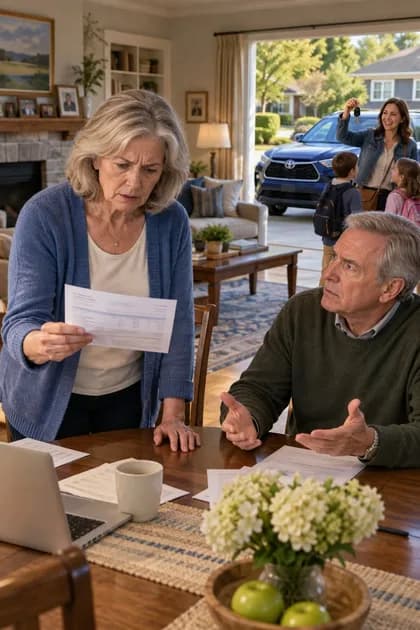
"MY MOTHER LOOKED AT MY WIFE—SIX MONTHS PREGNANT—AND SAID, “IF YOU’RE GOING TO FEEL SICK, THEN GO EAT IN THE BATHROOM.” THAT NIGHT, AFTER YEARS OF PAYING FOR EVERYTHING, I DECIDED TO HANDLE THE DISRESPECT IN A VERY DIFFERENT WAY."
“If your pregnancy is going to make you nauseous in the middle of dinner, then maybe you should eat in the bathroom so you don’t ruin the evening for my daughter’s family.”
She said it without lowering her voice, in the same calm tone someone might use to ask for salt.
She said it in front of the waiter, in front of my brother-in-law’s parents, in front of my sister—and in front of my wife.
And in front of me.
I didn’t raise my voice.
I didn’t throw anything.
I didn’t even react outwardly.
I just looked at Macy. Her eyes were filled with tears, one hand resting protectively over her stomach, as if shielding our child from the words she had just been forced to hear.
It all happened in a restaurant in Asheville, on a cool October evening, during a dinner celebrating my sister Sydney and her husband Grant’s first anniversary. My mother, Beverly, had insisted the night be “special”—which, in our family, always meant one thing: I would be paying for everything.
I’m thirty-four. I’ve spent over a decade working in investment funds, building a life from nothing. My father died when I was sixteen, leaving behind debt,
a house on the verge of foreclosure, and a family barely holding together. My mother worked exhausting shifts at a small diner, and I stepped in early—covering bills, tuition, groceries, whatever was needed.
When I started earning well, I continued doing what I always had—supporting them.
I paid off my mother’s mortgage, keeping the property in my name. I made sure she never had to worry about expenses—rent, food, medical care. I covered her insurance, her credit cards, even the “emergency” purchases that were rarely emergencies.
When Sydney got married, I paid for most of the wedding. Later, I gave her and Grant access to one of my rental homes at a reduced rate, bought them a car, and even set aside money for their future house.
I never talked about it. But that night, I realized something had changed.
They no longer saw it as help.
They saw it
as something they were entitled to.
Macy, my wife, is nothing like them. She’s a preschool teacher—gentle, kind, grounded. From the very beginning, my mother and sister made it clear they didn’t see her as “good enough.” Not directly—but through constant remarks about her simple background, her modest clothes, her quiet nature.
Macy always chose patience.
But the pregnancy made everything worse.
My mother started insisting that a “good wife” should stop working. Sydney criticized everything—her diet, her body, how she moved, how she rested. Always smiling while doing it, as if cruelty wrapped in politeness wasn’t cruelty at all.
That night, Macy had spent hours baking Sydney’s favorite cake—a light lemon cake with frosting. She even bought a navy dress because she wanted to look her best.
At first, dinner went smoothly. Grant’s parents were polite, if a bit uncomfortable. Macy spoke kindly with his mother about children and
teaching.
Then the drinks arrived.
Macy ordered sparkling water with lemon.
My mother laughed softly. “How sad. You can’t even enjoy a proper drink anymore.”
Macy smiled and brushed it off.
But Sydney pushed further, claiming carbonated drinks weren’t safe for the baby. Macy calmly said her doctor approved it. Sydney insisted a mother should give up everything for the child.
To avoid conflict, Macy quietly switched to still water.
I noticed.
I stayed silent.
Halfway through dinner, Macy turned pale and excused herself. The nausea had come suddenly—unpredictable, normal, nothing to be ashamed of. She returned a few minutes later and softly said she needed a moment before continuing to eat.
That’s when my mother looked at her—and said the sentence that changed everything.
“If you’re going to act like that, eat in the bathroom. This night isn’t about you.”
The table fell silent.
Grant stared down. His parents froze.
Sydney nodded slowly. “She’s right. You’re making everyone uncomfortable. If you couldn’t handle it, you shouldn’t have come.”
Macy flushed red. Her lips trembled.
And then she did the one thing that hurt me most—
She apologized.
Apologized for feeling sick.
Apologized for ruining the evening.
Apologized for being pregnant with my child at a table where she never should have been humiliated.
That’s when I stood up.
I smiled, took her hand, picked up the cake she had made with care, and said calmly:
“Enjoy your evening. I hope it’s exactly the kind of dinner you deserve.”
We walked out without creating a scene.
But as I drove us home, I knew something inside me had broken for good—
…and something new had hardened in its place.
I didn’t say a word the rest of the way home. I just kept one hand firmly on the steering wheel and the other wrapped securely around Macy’s hand. She cried silently, staring out the window, occasionally whispering that she was sorry she ruined the dinner. Every apology felt like a knife twisting in my ribs.
When we got to our house, I sat her down on the couch, wrapped a blanket around her shoulders, and brought her a slice of the lemon cake she had baked.
“You did nothing wrong,” I told her, kneeling so we were eye-to-level. “You are the best thing that ever happened to me. And tonight was the last time anyone will ever speak to you that way.”
She nodded, exhausted, and went upstairs to rest.
I went into my home office and opened my laptop. For years, I had believed that being a "good son" and a "good brother" meant shielding my family from the struggles we had faced when my father died. I had bought their comfort at the expense of my own peace, and now, at the expense of my wife's dignity.
Words would never work with Beverly and Sydney. They didn't respect boundaries; they only respected leverage. It was time to pull the plug.
### The Immediate Fallout
At 9:45 PM, my phone buzzed on the desk. It was my mother. I let it go to voicemail.
Five minutes later, Sydney called. I answered.
“Where are you?” she hissed, her voice dripping with venom. “The waiter just brought the check. It’s over six hundred dollars. They won't let us split it more than three ways, and Grant’s parents are sitting right here. Get back here and pay for this.”
“I’m at home,” I said, my voice entirely flat. “With my wife. As Mom said, it’s a special night, and since Macy was making everyone uncomfortable, we left so you could enjoy yourselves. The bill is yours.”
“Are you insane? We don’t have that kind of money in checking right now!”
“Then I suggest you figure it out. Have a happy anniversary, Sydney.”
I hung up and turned my phone on silent. Then, I got to work.
### Severing the Lifelines
I am an investment fund manager. My life is built on assessing risk, allocating resources, and cutting losses on bad investments. My family had become a toxic asset.
Over the next two hours, I dismantled the financial empire of comfort I had built for them:
* The Credit Cards: I logged into my American Express and Chase portals. I navigated to the "Authorized Users" tab. With three clicks, my mother’s card and my sister’s emergency card were permanently canceled.
* The Car: I logged into my auto insurance portal and removed Sydney's SUV from my policy. I sent her an email notifying her that as of midnight, the car was uninsured and the title would be mailed to her—along with the responsibility for the property taxes she’d never had to pay.
* The Properties: This was the heavy artillery. The house my mother lived in was legally mine. The rental Sydney and Grant occupied was legally mine. I drafted formal, legally binding 30-day notices. For my mother: a notice that I was putting the house on the market, and she had sixty days to vacate. For Sydney: a notice of lease termination. They could stay, provided they signed a new lease at the current, non-subsidized market rate—a 300% increase from what they were currently paying.
I printed the documents, put them in certified mail envelopes, and left them on my desk to be mailed the next morning.
### The Confrontation
The explosion happened two days later when the credit cards declined at a luxury spa and the certified letters arrived in their mailboxes simultaneously.
My mother showed up at my front door, pounding on the wood like a collection agent. I opened it, stepping outside and closing the door firmly behind me so Macy wouldn't have to deal with her.
Beverly’s face was purple with rage. "What is the meaning of this?! Eviction notices? Canceled cards? Have you lost your mind over a pregnant woman's hormone swing?"
"No," I said, looking down at the woman who raised me, realizing I felt absolutely nothing for her in that moment. "I gained my clarity."
"I am your mother! I raised you! We are family!"
"You raised me to be a wallet," I corrected her gently. "I paid my debt to you ten times over. I bought you a decade of luxury you didn't earn, and I funded Sydney's entire adult life. In return, I asked for nothing. But you couldn't even give my wife basic human decency."
"It was a joke! She was ruining the dinner!"
"She was carrying your grandchild," I said, my voice dropping an octave. "And you told her to eat in a bathroom. So, I am flushing your financial support down the toilet. You’re adults. Pay your own bills. Do not come to my house again."
I went back inside and locked the door.
### The New Normal
It has been six months since that night in Asheville.
Beverly tried to fight the eviction, but she had no legal leg to stand on and no money to hire a lawyer, since I was the one who usually paid for her legal retainers. She ended up moving into a small, cramped apartment in a cheaper town.
Sydney and Grant couldn't afford the market rent on their home. They had to downsize significantly, and without my credit card floating their lifestyle, the reality of living within their actual means hit them like a freight train. They tried sending flying monkeys—aunts, uncles, old family friends—to guilt-trip me. I blocked every single one of them.
Last week, Macy gave birth to our daughter, Lily.
The hospital room was quiet, peaceful, and filled only with people who loved us. There were no backhanded compliments, no demands for luxury, no underlying tension. Just my gentle, kind wife, smiling down at the life we created together.
I had spent my entire twenties building wealth to save a family that never truly loved me. But looking at Macy and Lily, I realized I hadn't lost anything. I had just finally invested in the right one.