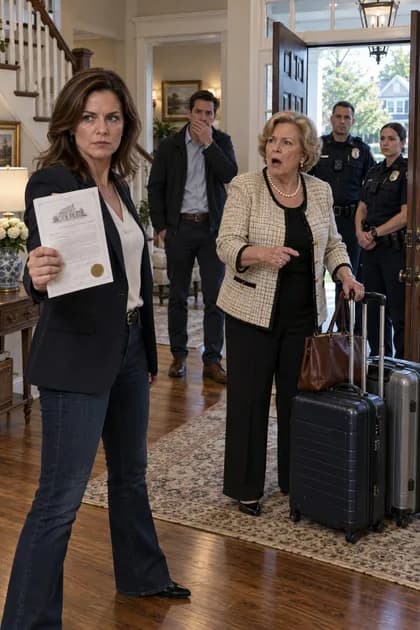
For the first time that afternoon, my mother stopped looking confident.
Chapter 2
PART 2 - THE NUMBER IN MY YELLOW FOLDER MADE MY FATHER GO PALE
1,012 words
I pulled out the county services report from when I was fifteen.
Then came the legal aid letter explaining that parents were responsible for a minor child’s food, clothing, housing, medical care, and school necessities.
Then bank statements.
Receipts.
Old rent demands.
Copies of every payment record I had managed to keep.
Mom stared at the pages.
“You kept all of this?”
“I learned from you,” I said.
Dad looked down.
I slid one final sheet onto the table.
“I went through every charge in your notebook that I could reconstruct,” I said. “Anything you billed me for while I was a minor—food, housing, school supplies, medical expenses—I removed from your total because those were your responsibilities, not loans.”
Mom’s mouth tightened.
Dean went silent.
“Then,” I continued, “I calculated the money I actually paid you before I turned eighteen.”
I turned the sheet around.
$18,460.
Dad’s face went pale.
Mom didn’t blink.
“That number is nonsense.”
“No,” I said. “It’s conservative.”
I showed them the deposits from my teen checking account. Cash withdrawal slips from the summers I worked at the ice cream shop. Money orders I had bought because Mom said cash was too easy to ‘forget.’ Notes in her own handwriting marking payments as received.
Two hundred fifty dollars at fifteen.
Three hundred at sixteen.
Three hundred fifty at seventeen.
Then groceries, school fees, prescriptions, utility contributions, and the money she took from birthday checks from relatives because, according to her, I had “household obligations.”
Dad picked up one bank statement.
His thumb stopped over a line item.
I noticed.
“So you remember that account,” I said.
His eyes lifted slowly.
Mom cut in. “Rick, don’t.”
That was when I knew there was something in the folder I hadn’t understood yet.
The account had been opened when
I was fourteen because I was too young to open it alone. Dad’s name had been on it with mine.
“I remember signing,” he said quietly.
Mom’s head snapped toward him.
Dean spoke through the phone. “Signing what?”
Dad swallowed.
“The bank paperwork.”
I leaned forward. “Did you know money was being withdrawn?”
Mom slapped her palm flat on the table.
“This is ridiculous. We are not on trial.”
“No,” I said. “You came into my workplace with a $52,000 bill. I’m answering it.”
I pulled out three copies of monthly statements from the year I was sixteen. Each showed my paycheck deposits. Each showed cash withdrawals within forty-eight hours.
I had always assumed Mom made me withdraw the money myself.
Two of those withdrawals, however, had teller codes rather than ATM codes.
Dad stared at them for a long time.
Then he said, “Your mother had the withdrawal slips.”
The room went silent.
Mom’s expression hardened.
“You gave me permission.”
“I gave you permission to pick up groceries when Paige was working late,” Dad said.
“You knew what the money was for.”
“I knew you were making her contribute. I didn’t know you were taking nearly every check.”
Nearly every check.
The words landed harder than the $52,000 bill had.
I had spent years wondering whether I remembered my childhood too dramatically. Whether I had exaggerated. Whether other families really did make teenagers “help out” and I had simply been too sensitive.
Now Dad was confirming the part I had never been able to prove.
Mom turned back to me.
“You lived under our roof. You ate our food. We were drowning back then.”
There it was.
Not denial.
Just justification.
Her father had disappeared when she was nine. Her mother had worked two jobs and counted coins at the kitchen table. I knew that story. Mom had told it often.
But somewhere along the way, she had turned survival into a moral system.
If hardship had been demanded from her, hardship became proof of character.
And if I resisted it, I became ungrateful.
“You were drowning,” I said. “So you put me underwater with you.”
Her face changed.
For the first time, she looked hurt.
Then the hurt vanished behind anger.
“You think that little house on Cornell Drive makes you better than us?”
Dad looked up sharply.
Dean said, “Mom.”
I froze.
I had never told her the street name.
I had told Dean only that I was buying a house.
Very few people knew the address because the closing wasn’t finished.
“How do you know Cornell Drive?” I asked.
Mom said nothing.
Dean’s breathing changed over the speaker.
I looked at the phone.
“Dean?”
He answered too quickly. “You probably mentioned it.”
“No. I didn’t.”
Dad shut his eyes.
That was the second time he had reacted before anyone else.
I put the papers down.
“What did you do?”
Mom reached for her notebook. “We came here to resolve a family debt, not be interrogated.”
I placed my hand on the gray cover before she could pull it away.
“You didn’t come here for $52,000,” I said. “You came here because you need me attached to something before my closing.”
Nobody spoke.
And suddenly Dean’s “two options” sounded different.
Co-sign their lease.
Or let them move into the house I hadn’t even bought yet.
Either choice tied my parents directly to the one thing I had built without them.
I looked at Dad.
“What aren’t they telling me?”
He rubbed both hands over his face.
“Rick,” Mom warned.
He ignored her.
“The landlord won’t renew without a guarantor,” he said.
“I know that part.”
Dad shook his head.
“No. You don’t.”
Then he looked toward the phone.
“Dean is already the guarantor.”
The speaker went completely silent.
I stared at it.
Dad continued.
“He signed two years ago. The lease they’re trying to replace is his.”
My mother closed her eyes.
And just like that, I understood why my brother had been working so hard to make my parents my responsibility.
He wasn’t rescuing them.
He was trying to get himself out.
Click the blue “PART 3” below to read the next part: 👉 PART 3 👈
Chapter complete
You have reached the end of this chapter.
Continue reading
Find your next story
A few more worlds to get lost in after this chapter.