Mason’s lawsuit did one thing his kitchen ambush had failed to do.
Chapter 4
PART 4 - THE FULL RECORD FINALLY DESTROYED THE CLAIM AGAINST OUR HOME
1,649 words
It forced everything into the light.
Every check Daniel had written.
Every loan Mason had received.
Every email Eleanor had sent.
Every message Daniel had used to calm his son down instead of telling him no.
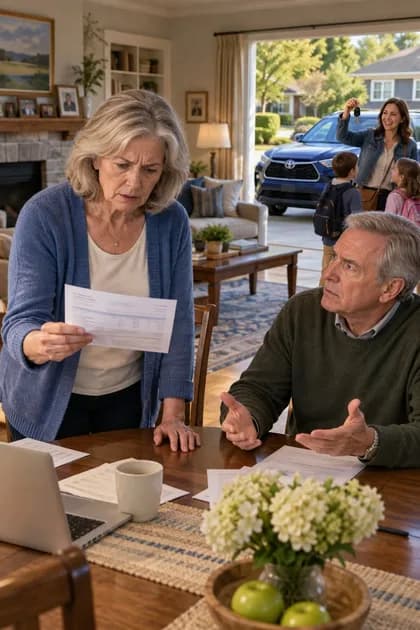
For three weeks, our dining room became a paper archive.
Daniel hated every minute of it.
I did not enjoy it either.
But I had learned something important.
Silence had protected this problem for years.
Documentation was going to end it.
Rachel asked Daniel to build a timeline.
So he did.
The first $40,000 transfer to Mason’s business.
The second $35,000.
A $12,500 payment Eleanor made toward one of Mason’s debts.
A series of smaller payments Daniel had made after that.
Then we found the message Mason had highlighted.
When I’m gone, half of what I have is yours.
It looked terrible by itself.
But Rachel asked for the entire conversation.
Daniel scrolled back
through an old cloud backup.
There it was.
Mason had been angry because Daniel had refused to invest another $60,000 in his company.
Mason: So Claire gets a new house and I get told no?
Daniel: Claire is paying toward that house too. This is not about choosing her over you.
Mason: You always said everything you built was for me.
Daniel: I said you’re my son and I’ll leave something for you. I’m not destroying my retirement to keep funding a business that is losing money.
Mason: So what do I actually get?
Daniel: Mason, I’m alive. This conversation is insane.
Mason: Answer me.
Daniel: When I’m gone, half of what I have is yours. But I am not giving you half of what I have while I’m alive.
The sentence Mason had submitted was real.
The meaning he attached to it was not.
And there was more.
Two
messages later, Mason had written:
Then put it in writing.
Daniel had answered:
No. I’m not making a contract with my son about my death.
Rachel read that twice.
Then she looked at us.
“That matters.”
The lawsuit did not disappear overnight. Real consequences rarely arrive as quickly as people want in stories.
There were filings.
Letters.
Attorney fees.
A mediation session in a gray conference room where the coffee tasted burnt and everyone looked exhausted before noon.
Mason sat across from us in a navy suit that made him look younger than twenty-six.
Eleanor sat beside him.
She was not a party to the case, but she had come for support.
For the first hour, Mason’s attorney argued that Daniel had repeatedly represented Mason as his eventual heir and that Mason had made financial decisions in reliance on those assurances.
Rachel answered carefully.
Being told you may inherit someday
was not the same thing as receiving a present ownership interest in a specific house.
Then she produced the full message thread.
Mason’s attorney read it.
His expression changed.
Mason stared at the table.
Eleanor whispered something to him.
Rachel produced records of the money Daniel had already given Mason.
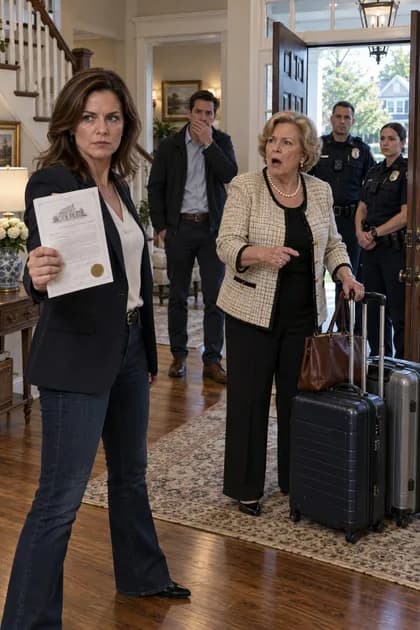
Then she produced the lender’s record showing that someone had contacted the bank using the old power of attorney information days before the kitchen confrontation.
Eleanor’s head snapped up.
Her attorney was not there because, until that moment, she had insisted she had nothing to do with the dispute.
Rachel did not accuse her of fraud.
She did not need to.
She simply asked Daniel, in front of everyone, whether he had authorized that inquiry.
“No,” he said.
Then she asked me whether I had authorized it.
“No.”
The mediator looked at Eleanor.
Eleanor’s face went gray.
“I was only asking what options existed.”
Daniel stared at her.
“You called my bank pretending to act under my power of attorney?”
“I did not pretend. I had the document.”
“You knew I had not asked you to call.”
“Mason was desperate.”
“That does not give you my life.”
Her eyes filled with tears.
“I raised your son.”
Daniel’s face tightened.
“I know.”
“I gave up everything.”
“I know.”
“And this is what I get?”
That sentence landed differently now.
Not because it was entirely false.
Eleanor had sacrificed.
She had stepped into a terrible situation when Daniel was a grieving young father.
She had changed diapers, stayed up through fevers, driven Mason to school, and helped hold a damaged family together.
But somewhere over twenty-six years, sacrifice had hardened into ownership.
Daniel finally understood it.
“You get my gratitude,” he said. “You get my love. You do not get control.”
Mason shoved his chair back.
“So that’s it? She wins?”
I had barely spoken all morning.
Now I did.
“This was never a contest between you and me.”
He laughed bitterly.
“That’s easy for you to say. You have the house.”
“I have part of a house I paid for with my husband. You have a father who has already given you more help than most people ever receive.”
“You don’t know what I lost.”
“No,” I said. “But I know what you tried to take.”
The room went silent.
Mason looked at Daniel.
“You said you’d always take care of me.”
Daniel’s eyes were wet.
“I said I’d always be your father. I confused that with rescuing you from every consequence. That was my mistake.”
For the first time since I had met him, Mason did not have an immediate answer.
The mediation broke for lunch.
When we returned, his attorney asked to speak privately with Rachel.
An hour later, Mason withdrew the demand tied to our home and agreed to dismiss the claim if both sides paid their own legal fees.
There were no dramatic handcuffs.
No judge slamming a gavel.
No billionaire arriving to save me.
Just a bad claim collapsing under the weight of complete records.
But there was one final condition Daniel insisted on.
Mason had to acknowledge in writing that he held no present ownership interest in our home and that any future inheritance would be determined solely by Daniel’s valid estate documents as they existed at the time of his death.
Mason hated it.
He signed anyway.
Eleanor left before the papers were finished.
For almost six months, we heard nothing from either of them.
The silence hurt Daniel more than he admitted.
Some nights, I found him sitting on the porch after dark, staring at the maple trees.
I never told him he had made the right choice.
It did not feel that simple.
Boundaries can be necessary and still hurt.
Then, one cold February afternoon, an envelope arrived.
It was from Mason.
Inside was no apology.
Not exactly.
There was a single sheet of paper.
I sold the truck. I closed the company. I’m working for someone else now. I’m paying the debt down. Grandma is still angry. I am too. But I understand now that Dad’s money was never my business plan.
Daniel read the last line three times.
Then he sat down at the kitchen table and cried.
Not because everything was fixed.
It wasn’t.
But because for the first time, Mason had described his debt as his own.
Months later, father and son met for coffee.
I did not go.
That relationship belonged to them.
Eleanor took longer.
Nearly a year passed before she came to our door again.
This time, she knocked once.
When I opened it, she looked past me toward the hallway.
“Is Daniel home?”
“Yes.”
She hesitated.
“I would like to speak to both of you.”
I let her in.
Not because I had forgotten.
Not because trust had magically returned.
But because a boundary is not the same thing as a wall.
We sat in the same kitchen where Mason had once pushed that folder toward me.
Eleanor folded her hands.
“I thought if I didn’t protect Mason, Rebecca would have died for nothing.”
Daniel’s face changed.
She continued.
“I know that makes no sense.”
“It makes emotional sense,” I said.
She looked at me.
“I resented you because Daniel stopped needing me the same way.”
There it was.
The truth beneath the money.
The house had only been the object.
The real struggle was over who got to define Daniel’s life.
Eleanor looked down.
“I was wrong to contact the bank.”
Daniel nodded.
“Yes.”
“I was wrong to bring Mason into your marriage.”
“Yes.”
Her mouth tightened.
“And I was wrong to treat your home like a family asset before either of you were dead.”
That almost made me smile.
Almost.
“I appreciate you saying it.”
Trust did not return that afternoon.
But something else did.
Honesty.
And honesty, I had learned, was a much better foundation.
We still live in that house outside Columbus.
The studio still fills with morning light.
Daniel still buys paintings he does not need.
Mason is rebuilding his finances slowly, without promises tied to anyone’s death.
Eleanor and I will probably never become close.
That is fine.
Family does not have to mean unlimited access.
And love does not require surrendering every boundary just to prove it is real.
Sometimes I think back to that Saturday afternoon when Mason slid a folder across my kitchen counter and expected me to sign.
The move that destroyed his plan was not slamming the door.
It was not blocking his number.
It was not even the paperwork Rachel prepared.
It was asking one question the day before:
What have we left unexamined because Daniel feels too guilty to look at it?
That question exposed the old power of attorney.
It exposed the promises.
It exposed the debt.
And eventually, it exposed the difference between helping someone and handing them control over your life.
I had spent years believing peace meant avoiding conflict.
Now I know better.
Sometimes peace is what remains after you finally close the door on what should never have been allowed inside.
THE END.
Chapter complete
You have reached the end of this chapter.
Continue reading
Find your next story
A few more worlds to get lost in after this chapter.