For several seconds, Mom did not move.
Chapter 4
For several seconds, Mom did not move.
Then she reached for the chair beside my bed and sat down slowly.
"There was no Navy tuition money," I said.
My education had been covered through scholarships, officer training, and years of service.
Mom shook her head.
"Not tuition. The money before that."
She meant the year I left home.
I had been eighteen, accepted into a naval ROTC program, and terrified Dad would find a way to stop me. I remembered Grandma slipping an envelope into my coat pocket the morning I left.
There had been twelve hundred dollars inside.
At the time, I thought it was every bit of cash she could spare.
Mom told me it was not.
Grandma had been sending money for me for years.
Birthday money.
College savings.
Emergency funds.
A small investment account she opened when I was ten.
Dad had intercepted almost all of it.
The initials C.H. in Grandma’s ledger
did not stand for a person receiving payments.
They stood for Custodial Holding.
Grandma had been replacing money Dad took.
Evelyn confirmed it the next morning.
The cedar chest contained bank statements proving Dad had withdrawn more than sixty thousand dollars from an account Grandma created for me while I was still a minor.
He used part of it to cover payroll at his construction company.
Another portion paid Claire’s first-year college expenses.
When Grandma discovered the withdrawals, she quietly began rebuilding the account in a separate trust Dad could not access.
By the time I joined the Navy, that replacement fund had grown to nearly ninety thousand dollars.
I never knew it existed.
Grandma had never told me because she feared Dad would pressure me for it.
The trust had continued growing.
With interest and investments, it was now worth more than one hundred and forty thousand dollars.
Claire
had known.
Not everything.
But enough.
Years earlier, she had found one of Grandma’s bank statements and confronted Dad.
Instead of telling me, she helped him keep it quiet because he promised her the house would eventually be hers.
That was the secret behind her message.
YOU HAVE NO IDEA WHAT’S IN THAT HOUSE.
She had not been warning me about Grandma.
She had been warning me about them.
When prosecutors confronted Claire with the financial records, she accepted a cooperation agreement.
She admitted she had helped prepare the sale contract she carried into my hospital room.
She admitted she knew Dad intended to intimidate me.
She admitted the plan was to rush the sale before lenders learned the inheritance documents were false.
In exchange for her testimony, prosecutors agreed to consider her cooperation when charging decisions were finalized.
Dad refused every offer.
He insisted Grandma had promised him the
property.
He insisted I had provoked him.
He insisted Claire had misunderstood his intentions.
Then the doorbell video was played in court.
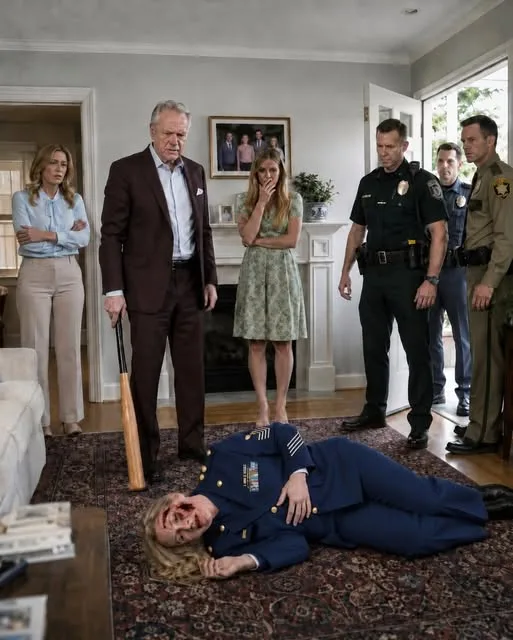
It showed him walking up Grandma’s front steps carrying the baseball bat.
It captured Claire saying, "Don’t come out without her signature."
It captured Dad replying, "She’ll do what she’s told."
There are moments when a family story ends not because someone apologizes, but because the lie holding everyone together becomes impossible to repeat.
That video was ours.
Dad eventually pleaded guilty to felony assault and multiple fraud-related charges after forensic accountants tied the forged documents to his loan applications.
His construction company entered bankruptcy.
Several creditors seized equipment and vehicles.
The house was never touched.
It could not be.
Grandma had made sure of that years before.
Claire sold her SUV.
Then her house.
She moved into a rental twenty minutes from Mom and took a full-time job for the first time in years.
We did not reconcile.
At least not in the way people expect sisters to reconcile at the end of a story.
She apologized once.
I believed she regretted what happened.
I did not believe regret erased participation.
Mom filed for divorce.
That surprised everyone except Evelyn.
"Your grandmother always hoped she would leave him," she told me.
Mom moved into a small apartment near the harbor.
For the first few months, she called me too often.
Then not enough.
We had to learn how to speak without Dad standing invisibly in the middle of every conversation.
It was slow.
But it was real.
Three months after the attack, I returned to Grandma’s house alone.
My ribs had healed.
The bruises were gone.
The braided rug had been professionally cleaned, but I replaced it anyway.
I could not look at the pattern without remembering Dad’s boots beside my face.
I carried the old rug to the garage and opened every window in the living room.
Fresh salt air moved through the curtains.
Above the fireplace were Grandma’s photographs.
One showed Claire and me as children on the back steps.
Another showed Dad at twenty-five, smiling beside a truck from the first year of his construction company.
For a long time, I considered taking that one down.
Instead, I left it.
Not because I forgave him.
Because the house no longer needed to be edited around him.
Truth was enough.
Evelyn arrived that afternoon with one final envelope.
Grandma had instructed her to deliver it only after every legal challenge to the trust had ended.
The letter inside was written in blue ink.
Emily,
If you are reading this, then Harold finally learned what I could never teach him: ownership is not love, and fear is not loyalty.
This house is yours because you never asked me for it.
You came here when the gutters needed cleaning. You drove me to appointments. You sat on the porch and listened when I repeated the same stories.
Claire loved me too, in her way.
Your father may even believe he loved me.
But love that comes with a bill is not love I wanted to reward.
Do not keep this house because I gave it to you.
Keep it only if it gives you peace.
And if it does not, sell it without guilt.
A house is wood and stone.
Family is what people choose to protect.
Grandma
I read the letter twice.
Then I walked through every room.
The cedar chest was still beneath the staircase.
I found the brass key in the leather folder and unlocked it one final time.
At the bottom, beneath the ledgers and copies investigators had returned, was a photograph I had never seen.
It showed Grandma standing beside me at my Navy commissioning ceremony.
I was in uniform.
She was looking at me instead of the camera.
On the back she had written:
THE FIRST HART WHO LEARNED SHE DID NOT HAVE TO BE AFRAID.
I sat on the stairs and cried harder than I had in the hospital.
Not because of Dad.
Not because of Claire.
Because Grandma had seen me clearly long before I learned to see myself.
A year later, I made my decision about the house.
I did not sell it.
I converted the detached workshop into a small furnished apartment and partnered with a local nonprofit that helped women leaving violent homes.
The first resident was a mother with a six-year-old son.
They stayed four months.
Before they left, the boy drew a picture of the house and taped it to the refrigerator.
Underneath it, in uneven letters, he had written SAFE HOUSE.
I kept the drawing.
Dad had wanted Grandma’s property to rescue his failing company.
Claire had wanted it to rescue her lifestyle.
Grandma had wanted it to protect me.
In the end, I decided protection did not have to stop with me.
The last time I saw Dad was at a sentencing review hearing.
He looked older.
Smaller.
When the deputies brought him past the gallery, he saw the captain’s insignia on my uniform.
For once, he did not call me selfish.
He did not call me disobedient.
He did not call me his daughter.
He only looked away.
Years earlier, that would have hurt.
Now it felt like freedom.
Because the truth was simple.
I had never been the unwanted daughter.
I had only been unwanted by people who needed me to stay small.
Grandma knew the difference.
And when the sirens came that night, so did I.
THE END.
Chapter complete
You have reached the end of this chapter.
Continue reading
A few more worlds to get lost in after this chapter.